The interface is not the product
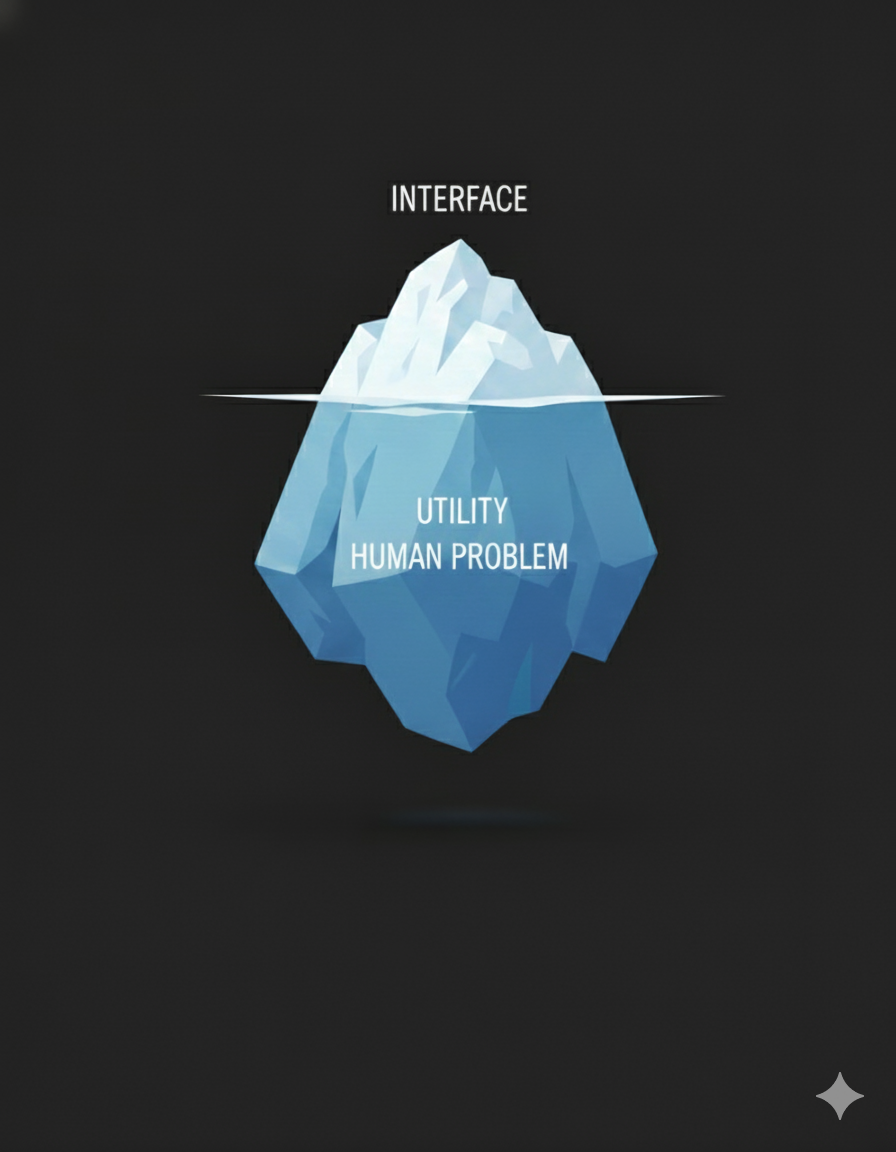
The most frequent and frustrating error I see among builders is a failure of abstraction: they fundamentally confuse the interface with the product.
Ask a young programmer what they're building, and the answer is almost always a description of the interface: "I'm building an app," or "It's a platform." This focus on the technical wrapper reveals that they only perceive the product through its immediate, visible artifact: the code, the UI.
But a product, at its core, is not code. A product is fundamentally a utility: a mechanism for changing a user's life by persistently reducing a pain or increasing a gain. That utility exists entirely outside of any specific interface. It is the outcome the user hires the product to achieve, defined in user-centric, pre-solution terms. The interface (the app, the code, the tool) is merely the delivery system.
This utility is a general concept. It applies whether you're building a network protocol or a neighborhood service. The crucial, often-missed realization is that the utility is addressed to, and designed for, the human being. Your server stack, your design system, your infrastructure are just tools and materials. The true medium you are working with, the thing you are shaping and influencing, is the human. If the utility fails to solve their problem, the app, no matter how elegant the code, is a useless distraction.
This confusion between the utility and the interface is precisely why simple, great advice like "Talk to Customers" and "Solve a real problem" is so often misunderstood, dismissed as banal, or executed poorly.
Builders, fixated on the interface, feel compelled toward premature formalization. They'll tell you, "We're planning to schedule user interviews," or "We will conduct market research," substituting genuine discovery with procedural compliance. This is intellectual cowardice masquerading as planning, a search for confirmation rather than a confrontation with reality.
You don't need a sophisticated framework. If you are trying to build a CRM solution for restaurants, you don't need a lab. You need to walk into three nearby restaurants and ask about their pain points, their existing workflows, and the tools they tolerate. This simple, direct confrontation with reality is infinitely more valuable than writing a single line of code for a problem whose existence you haven't validated.
If you think the app is the product, your customer conversations will inevitably become shallow, focusing on features rather than fundamental friction. These discussions consist mainly of validating your preconceived solution rather than extirpating a problem from reality. The focus shifts immediately to the solution, not the problem.
When I talk to new builders, the first question that pops into my head is always: "How many people with this problem have you spoken to before whipping up that Next.js component or buying that domain name?"
The error is classic: grabbing the toolbox (the interface/code) before opening the hood (understanding the utility/problem) to diagnose the issue. Code offers the illusion of progress. Moving a button is a deterministic, solvable problem that gives immediate feedback, while talking to a customer is messy, non-deterministic, and often yields frustrating answers. Builders naturally choose the measurable progress of the interface over the messy uncertainty of the utility.
Product building must begin and end with the human. The code is only an efficient servant in the middle.
Opening an IDE should be the last step.
The ultimate test for whether you truly understand the utility you are building is simple, and it demands humility and labor: Can you deliver the core value through a completely manual, non-technical workflow?
If you cannot deliver the utility by doing the work yourself first—if you must have the code to prove the value—then you have not validated the utility. You have only validated your desire to build a piece of software. The utility must be rock-solid and human-validated, even if delivered via spreadsheets and email. The manual process forces the builder to become the "software" first, absorbing the latency, the emotions, and the true cost of the current solution, ensuring the interface is simply the scaling mechanism built on top of that proven, essential workflow.
Subscribe